Designing a luxury villa requires meticulous attention to detail, especially when creating personal sanctuaries like the master bath. Today, interior design has shifted from treating washrooms as purely functional areas to transforming them into experiential, spa-like retreats. The right choice of materials can elevate an ordinary layout into a five-star property asset.
When selecting bathroom tiles in UAE, homeowners must balance aesthetic grandeur with practical durability against the region’s specific climate and humidity levels.
Incorporating luxury bathroom tiles not only boosts the overall property value but also provides a daily experience of indulgence and comfort. At SC Home (Schome), we have spent decades helping clients across the region build the homes of their dreams. Here are seven stunning, expert-backed design ideas to inspire your next villa renovation project.
Create a Spa-Like Oasis with Large-Format Porcelain
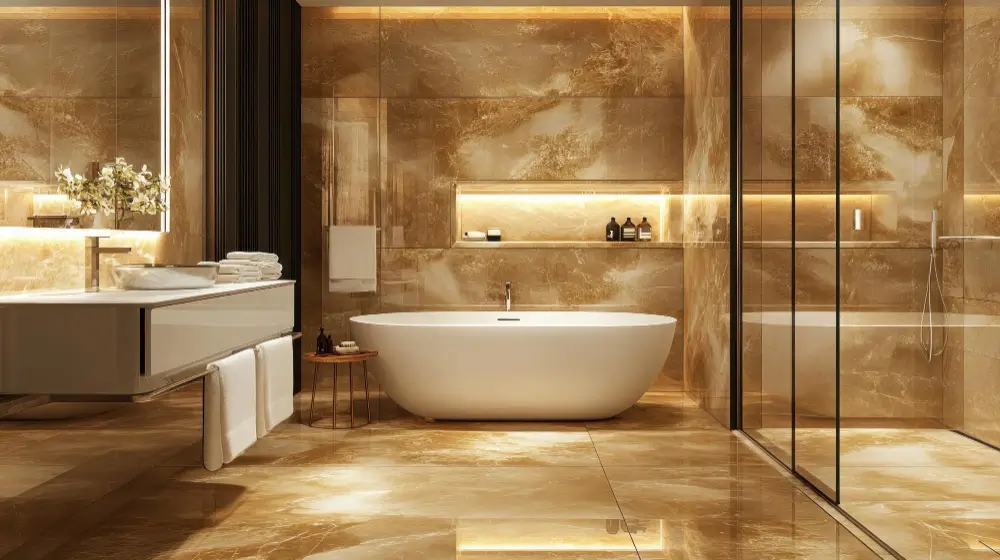
Oversized rectified slabs minimize visible grout lines, producing seamless, expansive surfaces that make any bathroom feel significantly larger. This approach is particularly powerful in UAE villa master suites, where spacious layouts give these grand dimensions room to breathe.
High-end large-format bathroom tiles in UAE closely mimic the monolithic beauty of carved stone without the porosity and resealing demands of natural material. Pair light-coloured slabs with recessed ambient lighting and frameless glass partitions for a true five-star wellness retreat aesthetic.
Opulent Marble Finishes for Timeless Elegance
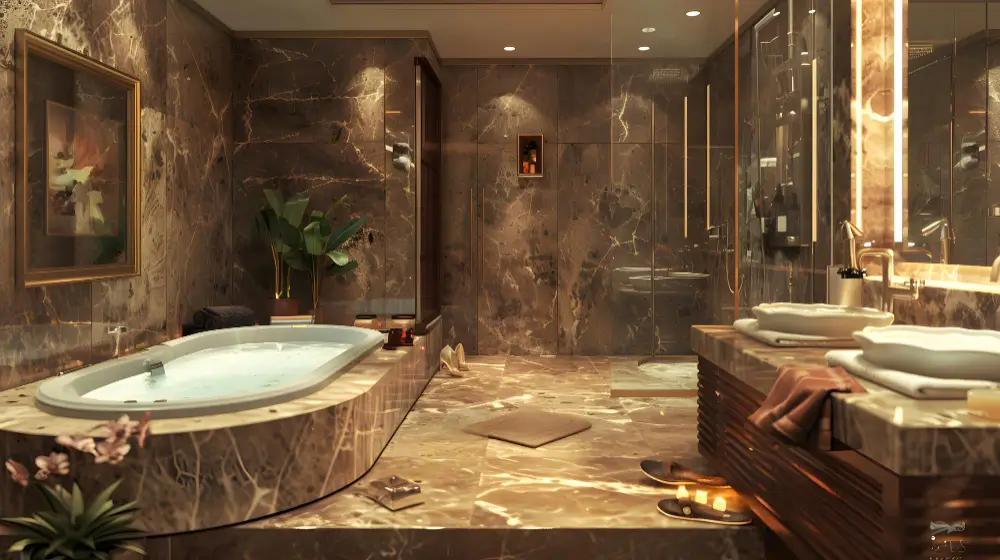
Marble has defined high-end architecture for centuries, and it remains the most requested finish among homeowners sourcing luxury bathroom tiles in UAE. Modern polished glazed vitrified tiles (PGVT) replicate the deep veining and luminous surface of natural stone while offering superior water resistance and zero resealing requirements.
Carry marble-effect tiles across both floors and walls to create a complete envelope of elegance. Choose dramatic dark Emperador veining for a moody, contemporary feel, or classic Carrara white for a bright, timeless result.
Textured Anti-Slip Surfaces for Safe Wet Rooms
Walk-in showers and expansive wet rooms are the most sought-after features in UAE villa bathrooms — but safety must be built into the tile specification from the start. Always check the R-rating of any tile intended for a wet floor: R10 is the minimum for domestic wet rooms; R11 offers extra grip for barefoot use on continuously wet surfaces.
The latest tile manufacturing technology means anti-slip bathroom tiles in UAE no longer look utilitarian. Matte concrete finishes, slate textures, and micro-relief surfaces all achieve high R-ratings while remaining visually refined and consistent with luxury interiors.
Metallic Accents and Brushed Gold Elegance
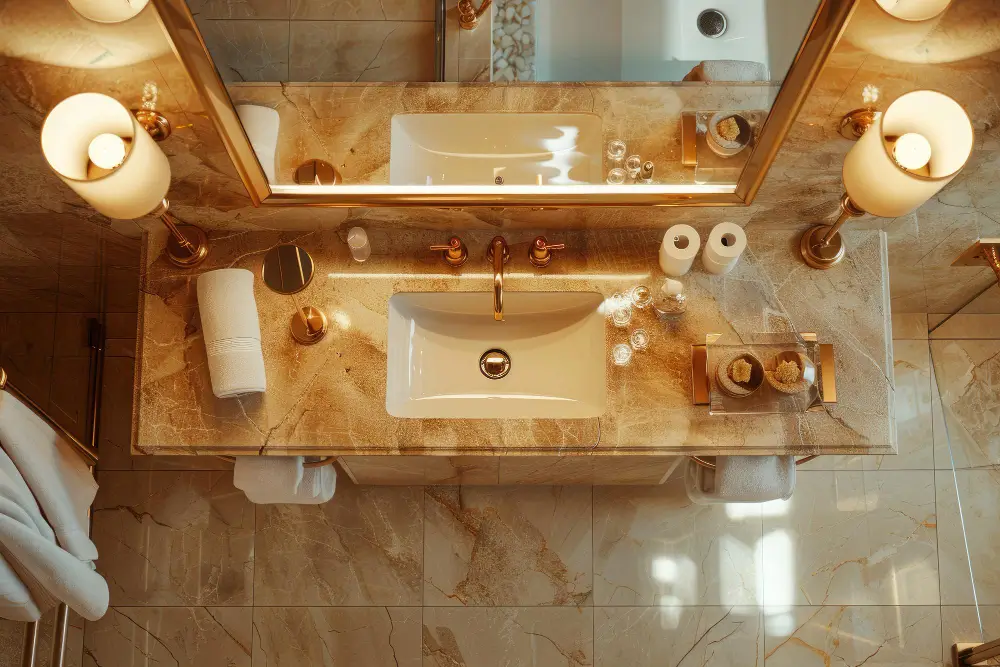
Metallic trim profiles interspersed within a primary tile layout create striking focal lines that draw the eye toward key architectural features — a freestanding soaking tub, a dual vanity, or a floor-to-ceiling shower wall. Brushed gold, aged brass, and matte black are the three finishes that currently dominate high-specification residential projects across the UAE.
Pair these accents with luxury bathroom tiles in UAE in muted, sophisticated tones — charcoal grey, deep navy, or forest green — and the metallic elements will pop brilliantly, reflecting the room’s ambient light and adding warmth to otherwise cool stone surfaces.
Wood-Look Tiles for Warmth and Contrast
Natural timber brings warmth and organic texture into spaces typically dominated by cold stone and glass. However, real wood warps, rots, and degrades rapidly in the high-humidity environment of a UAE bathroom. Porcelain wood-look planks solve this entirely: they replicate the authentic grain and colour variation of timber while being completely impervious to moisture.
Use these bathroom tiles in UAE as a feature wall behind an LED vanity mirror, or as flooring contrasted against sleek white ceramic walls, to introduce a rich earthy balance into an otherwise modern, minimalist interior.
Bold Moroccan Patterns for Statement Walls
A single statement wall of intricate, patterned tile transforms a neutral bathroom into a room with genuine personality and artistic depth. Interior designers across the UAE are increasingly moving away from fully monochromatic palettes, using decorative bathroom tiles in UAE inside shower enclosures or as vanity backsplashes to inject a boutique-hotel character.
Geometric Moroccan motifs, arabesque interlocking patterns, and hand-painted zellige-style surfaces all work beautifully as a single focal point, particularly when the surrounding walls and floor are kept in calm, neutral tones that allow the feature tile to command the space.
Seamless Indoor-to-Outdoor Tile Transitions
Many UAE villas feature private terraces, sunbathing courtyards, or outdoor shower areas attached directly to the master suite. Continuing the same tile from the interior floor straight through to an outdoor terrace visually doubles the room’s footprint. It creates a sophisticated architectural flow that is a hallmark of contemporary luxury design.
The critical specification requirement: select luxury bathroom tiles in UAE that are rated for both interior use and exterior exposure. The tile must withstand daily steam and moisture inside while also resisting the intense UV radiation and thermal cycling of outdoor UAE conditions, typically exceeding 45°C in summer.
Why Choose SC Home for Bathroom Tiles in UAE?
With decades of experience supplying premium tiles across the UAE, SC Home is not just a supplier — we are a design partner committed to helping homeowners and developers bring exceptional spaces to life.
UAE-Rooted Expertise
Our team understands the UAE’s climate, construction standards, and design trends firsthand — ensuring every recommendation is grounded in real regional experience.
Exclusive Collections
From the Tredex TR+ brushed gold sanitaryware range to our curated decorative pattern tiles, our catalogue is carefully selected for luxury residential projects.
End-to-End Support
We guide you from first concept to final installation — helping you calculate quantities, choose the right adhesives, and match finishes for a fully cohesive result.
4 Showroom Locations
Visit us in Sharjah, Al Ain, Ras Al Khaimah, or Sajaa to see our full range in person and consult directly with our in-house design specialists.
Customer Questions
How many tiles do I need? How do I avoid over-ordering or under-ordering?
Measure your total floor and wall area in square metres, then add 10% for wastage on straightforward rectangular rooms and 15% for rooms with complex cuts, alcoves, or diagonal patterns.
Always buy from the same production batch (lot number) to ensure colour consistency — tile shading can vary slightly between manufacturing runs. SC Home’s team can calculate exact quantities for you during a consultation.
Can I mix tiles from different collections or brands?
Yes, and this is often the best design approach. A common strategy is a neutral large-format tile on the floor paired with a patterned or textured tile on one feature wall. The key rules: ensure the undertones (warm vs. cool) are compatible, and confirm that the tile thicknesses are compatible for a flush finish.
Our design team can bring together samples from different collections for you to view under the same lighting conditions before committing.
What is the difference between porcelain and ceramic tiles for a bathroom?
Porcelain is fired at higher temperatures and has a water absorption rate below 0.5%, making it nearly impervious to moisture — ideal for UAE bathrooms.
Ceramic has a higher absorption rate (up to 3%) and is better suited to dry areas like bedroom feature walls. For any surface that comes into contact with water — shower floors, wet room walls, bathtub surrounds — always specify porcelain. Ceramic can be used for dry bathroom walls and vanity backsplashes as a cost-effective option.
Are marble-look porcelain tiles as good as real marble?
For bathroom applications, marble-look porcelain (PGVT) is often superior to natural marble in practical terms. Natural marble is porous and requires periodic resealing, stains easily from acidic products like shampoo and soap, and is susceptible to etching.
Porcelain PGVT tiles require no sealing, resist staining, and maintain their finish indefinitely. The visual difference in a finished room is minimal — modern digital printing technology reproduces veining, depth, and translucency very convincingly.
Can I tile over existing bathroom tiles, or do they need to come off first?
Tiling over existing tiles is possible if the original tiles are fully adhered with no hollow spots, the substrate is structurally sound, and the added height will not cause issues with door clearances or drainage levels.
However, for luxury renovations, we generally recommend removal. Installing on a clean, level substrate gives a better bond, eliminates the risk of hidden moisture damage, and produces a flatter, more professional finished surface — especially important for large-format tiles.

What Are the Best Tiles for Bathrooms in UAE?
Tiles For Residential Spaces: Designing Living Rooms, Bedrooms And Kitchen